
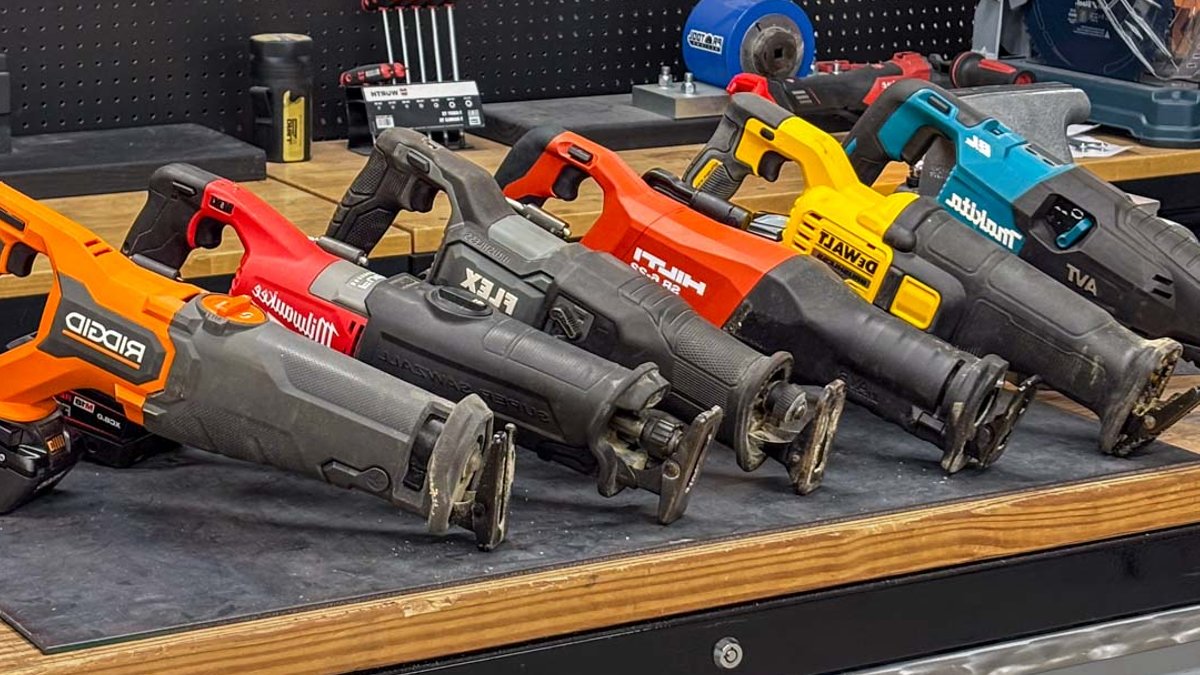
Pro Tool Reviews follows a consistent process when testing reciprocating saws, aiming to reveal how each model performs under realistic conditions that professionals encounter on the job.
Standardized Test Setup
Every test begins with a fully‑charged battery taken straight from the charger, ensuring each saw starts with the same maximum voltage boost before the battery settles into its nominal level. The second constant is a new blade for each run; this eliminates variations caused by blade wear and lets the saw work through the same blade‑life progression. Finally, they watch for outlier results, inconsistent cuts, or any user errors. If anything unusual occurs, the run is repeated to verify the result.
Cutting PVC Pipe
The first practical test uses a 4‑inch schedule 40 PVC pipe, a material common to plumbers, irrigation technicians, and municipal crews. With the saw set to its highest speed and orbital action disabled, a 5‑lb weight provides equal downforce across all models. The blade rests on the pipe, the trigger is fully engaged, and the average of three runs is recorded.
Related: Heat Pump Upgrades Get Efficiency Boost
Vibration can affect starting accuracy and edge quality, especially on tools with constant orbital action. A soft‑start feature, when present, can reduce the initial jolt and produce a cleaner cut, which matters to professionals who need both speed and precision.
Wood Cutting Performance
To gauge cutting speed in a demolition‑type scenario, the testers use two 12‑foot pieces of pressure‑treated pine. The material is wider than typical studs, allowing the saws to demonstrate differences over longer cuts. Each saw operates in high‑speed mode with orbital action turned on if the model includes it. The average of three successful runs determines the reported speed.
Because demolition often involves cutting through framed walls, they also created a mock‑up wall consisting of three 2 × 4 pine studs, each with three framing nails, a layer of 7/16‑inch OSB sheathing, and a HardieBoard siding layer. The studs are spaced closer together than on a standard job site, and the same downforce is kept consistent. All saws must cut through nine nails total, with high‑speed mode and orbital action engaged. The average of three cuts is reported.
Related: Bozeman landmark gets new life
When cutting cast‑iron pipe, a material known for its difficulty, the testers could not apply the same downforce method, so they cut freehand, aiming for the fastest possible cut in high‑speed mode with orbital action off.
Reporting Results
When the reviewers publish their findings, they include details about the materials cut, the blades used, and the outcomes of each test. This transparency lets readers gauge relative performance across different models and choose a tool that matches their specific needs, whether that’s rapid cutting, low vibration, or durability in demanding environments.


Leave a Reply