
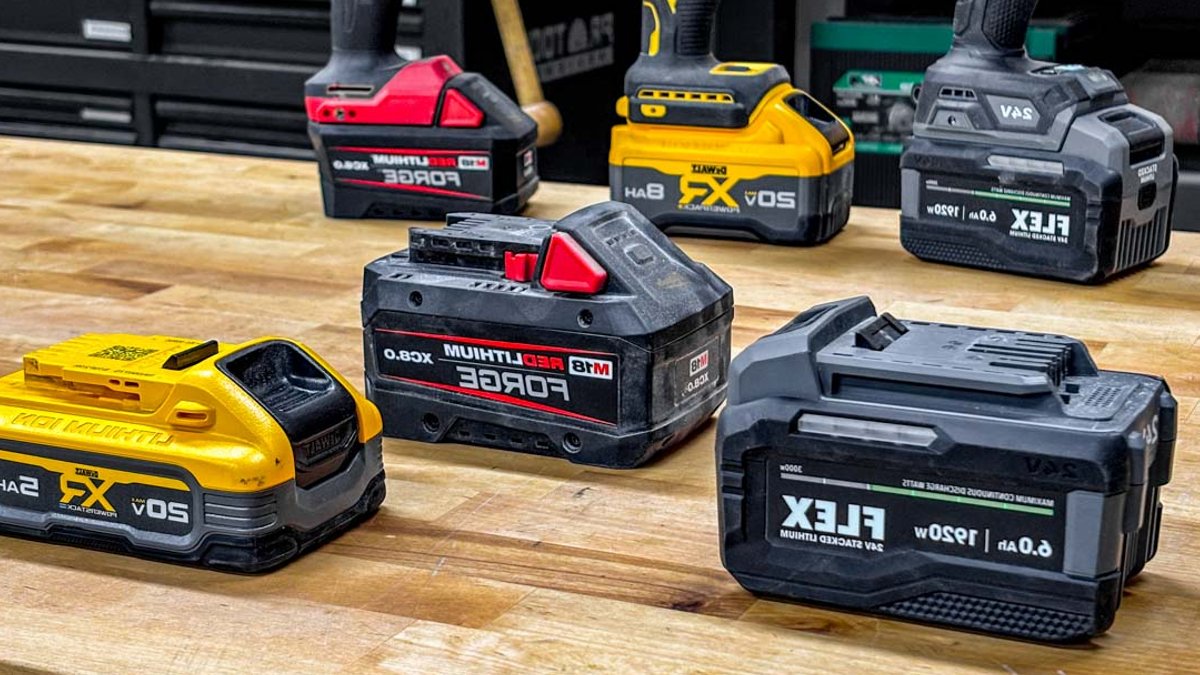
Testing shows that the extra cell in a 24V battery system does not automatically translate into a consistent 20% performance boost over comparable 18V tools.
Design differences that matter
Both 18V and 20V Max batteries contain five lithium cells. When manufacturers quote “20V Max,” they are using the cells’ peak voltage of 4 V each (5 × 4 V = 20 V) rather than the nominal 3.6 V (5 × 3.6 V = 18 V). A 24V system adds a sixth cell, giving a nominal voltage of 21.6 V (6 × 3.6 V) but marketed as 24 V Max (6 × 4 V).
On paper, a 24V pack can deliver about 20 % more power if the same current runs through each cell. For instance, at 50 A the theoretical output rises from 1,000 W (5 × 4 V × 50 A) to 1,200 W (6 × 4 V × 50 A). Conversely, achieving the same wattage with a 24V pack requires each cell to draw less current, reducing stress on the battery.
Head‑to‑hand test results
Three real‑world comparisons were run with Milwaukee (18V), DeWalt (20V Max) and Flex (24V) tools. In a rotary‑hammer test, maximum speeds ranged from 2,100 RPM (Milwaukee) to 2,500 RPM (Flex). Blow rates peaked at 40,000 BPM for the Flex model, but overall performance gaps were modest.
Specific tasks highlighted the mixed outcomes. The RSS screw test on the hammer showed Flex at 2.22 seconds, edging Milwaukee’s 2.49 seconds, yet DeWalt completed it in 2.42 seconds. In concrete drilling, Flex recorded 5.65 seconds, closer to Milwaukee’s 6.84 seconds than DeWalt’s 6.39 seconds.
Related: Bozeman landmark gets new life
Overall, the data does not support a blanket claim that 24V tools are uniformly 20 % stronger. Performance varies by task, motor design and how each manufacturer tunes the tool’s electronics.
The basic technology is more detailed. Battery voltage is just one factor among many that influence a tool’s output. Motor efficiency, gear ratios, internal resistance, and thermal management all play significant roles. A well‑engineered 18V tool can outperform a poorly designed 24V counterpart, while a premium 24V model may excel where the extra voltage aligns with its motor’s sweet spot.
Looking ahead, the key will be how manufacturers balance voltage with other design choices. If a 24V system is paired with a motor that can fully exploit the higher voltage, users may notice a genuine edge in demanding applications. Conversely, if the tool’s circuitry limits power draw, the theoretical advantage shrinks.
For most professionals, the decision between 18V and 24V platforms should hinge on the specific tool lineup, durability, and ecosystem compatibility rather than nominal voltage alone. Both systems now offer comparable speed, torque and run‑time across a range of common tasks.
Choose the tool that fits the job.


Leave a Reply