
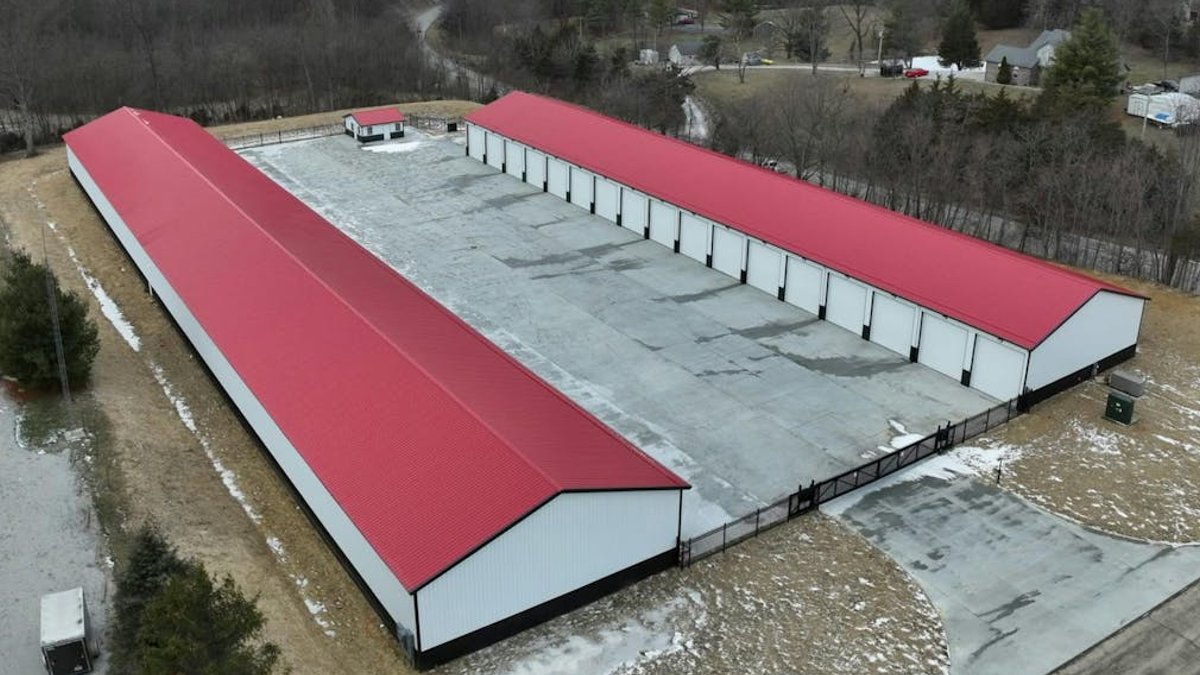
The self-storage industry has grown into a $40 billion real estate sector, with developers increasingly prioritizing climate control to meet demand. One contractor recently designed a new facility using low-temperature radiant heating to address the unique challenges of these spaces. The project involved two buildings totaling 31,000 square feet, where the goal was to maintain efficiency and predictable operating costs.
Tall corridors create air stratification, forcing warm air to rise to the ceiling while the floor remains cold. Frequent door openings allow this warm air to escape, forcing equipment to work harder to maintain the setpoint. This results in uneven temperatures from unit to unit and higher energy consumption.
Because storage spaces are designed for temperature maintenance rather than comfort conditioning, they are well-suited for radiant systems. These facilities typically operate between 50 and 60 degrees Fahrenheit. Instead of heating air that constantly escapes, radiant heating warms the building mass, including the slab and stored contents. This creates a thermal buffer that allows the space to recover quickly after a door opens.
Design and Installation
The design called for PEX tubing to provide consistent floor temperatures across long corridors. Supply water temperatures were kept between 90 and 120 degrees Fahrenheit, which paired well with high-efficiency gas boilers. The system relied on two boilers: one 500,000 BTU/hr unit for the larger building and a 400,000 BTU unit for the smaller one.
Related: Expanding Your Plumbing Business in a Sluggish Market
Proper insulation was critical for the project’s success. The concrete contractor provided a two-inch foam board insulation with an integrated PEX grid. This allowed installers to walk the tubing into the grid rather than zip-tying it to a road mesh every few feet. The project required roughly seven miles of tubing, making the grid system a significant time-saver.
Because the buildings were large, the team used 5/8-inch PEX tubing to extend loop lengths to about 375 feet each. The larger building used six manifolds with nine loops, while the smaller building used five manifolds with nine loops. The systems have been running since December 2023 without operational issues.
For facility owners and operators, the benefits of this approach extend beyond the initial construction costs. Because the heat is stored in the concrete structure, the system is less reactive to the rapid temperature fluctuations that plague traditional HVAC setups. A tenant walking through a corridor won’t feel a sudden chill when a door opens, and the building’s thermal mass absorbs the energy rather than forcing the boilers to cycle aggressively.


Leave a Reply